This project begins with a simple recognition: that much of what matters lies beyond immediate visibility.
It proceeds from the understanding that drawing offers a way of engaging with this condition, not by making the unseen fully visible, but by remaining in relation to it.
To draw, in this sense, is to move through the world attentively.
Not to arrive at a final understanding, but to remain open to what continues to emerge.
And to follow, as closely as possible, the traces of what lies just beyond view.
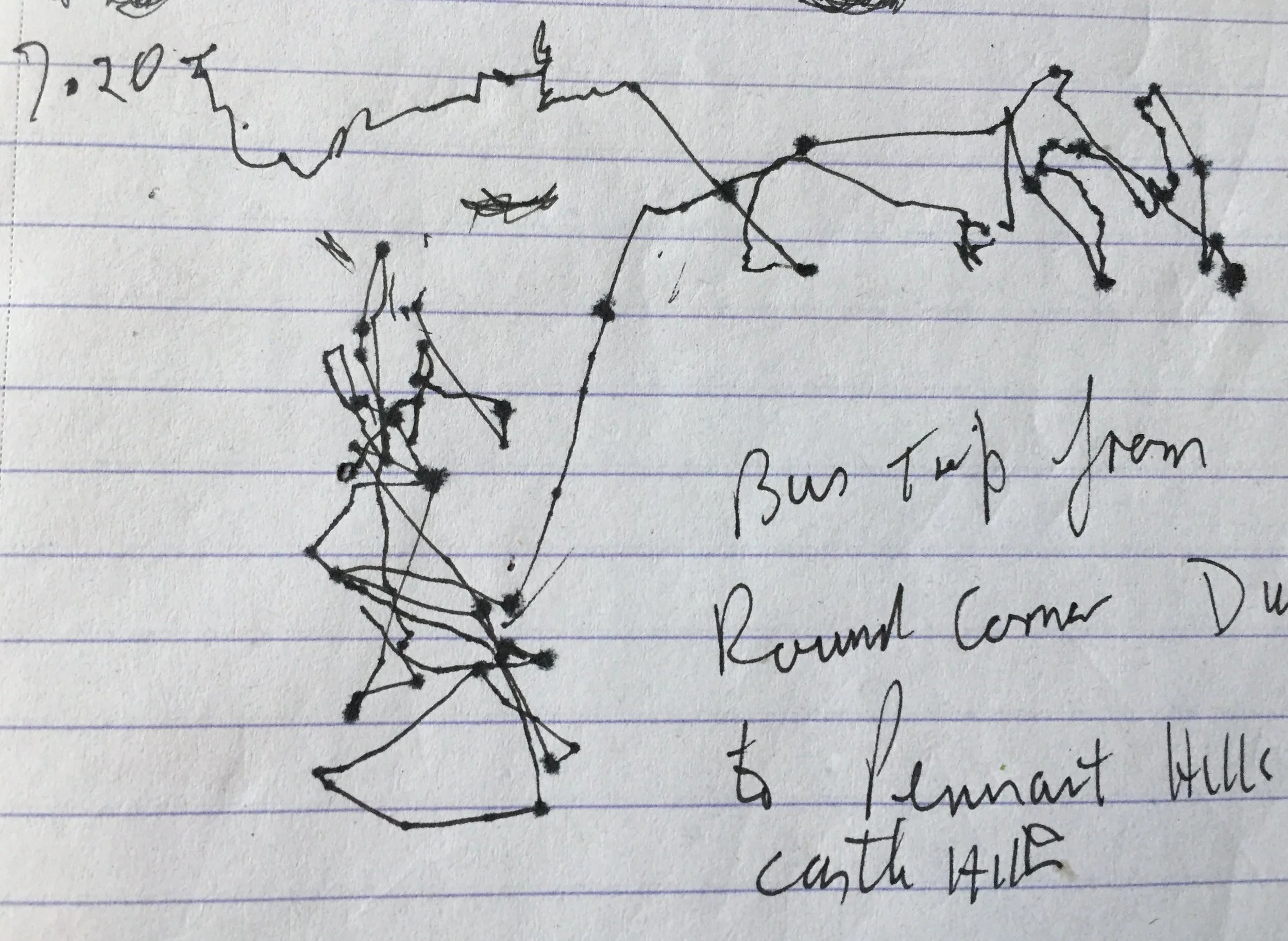
This drawing emerges from a bus journey taken from Pennant Hills toward the city, yet it does not attempt to depict the route, the landscape, or the recognisable markers of transit. Instead, it traces the felt movement of travel, the subtle shifts of balance, the rhythms of acceleration and pause, the quiet negotiations between body, awareness, and motion.
The project begins with a simple recognition: that much of what matters in our experience lies beyond immediate visibility. The world is always exceeding what can be directly seen. Drawing, in this context, becomes a way of staying in relation to that excess, not by trying to make the unseen fully visible, but by acknowledging its presence and allowing it to shape the mark‑making.
To draw is, here, to move attentively. It is a form of cognition that unfolds through the hand, a way of thinking that remains open rather than conclusive. The line becomes a companion to perception: following the sway of the bus, the interruptions of traffic, the small recalibrations of balance, the drifting of thought. What appears on the page is not a diagram of the journey but the residue of being carried through space.
This work invites viewers to consider how movement inscribes itself within us, how travel is not only a change of location but a shifting field of awareness. The drawing holds the traces of what lies just beyond view: the peripheral, the half‑noticed, the sensed rather than seen. It is an act of staying with emergence, of allowing the world’s subtle motions to register as line.
In this way, the drawing becomes less a record of where the artist travelled and more a record of how the journey was lived, a quiet cartography of attention.
This same condition unfolds in the act moving through, by walking or running…especially trail running, where perception is immediate, embodied and constantly adjusting. Each footfall becomes a form of sensing. The ground is not fully known in advance, it is encounted in fragments, shifts in texture, incline, moisture, resistance. The foot, like the eye in drawing, learns to read and respond before conscious thought intervenes. It finds its placement instinctively, negotiating rocks, roots and uneven terrain with a kind of tacit intelligence.
Drawing becomes inseparable from this experience. The hand, like the foot, moves ahead of cognition. Marks arrive on the page before they are fully understood, guided by rhythm, repetition, and subtle feedback from the surface. As in running, there is a continuous dialogue between body and environment, an attunement to forces that cannot be entirely seen or predicted.