Drawing through movement
This project begins with a simple recognition: that much of what matters lies beyond immediate visibility.
It proceeds from the understanding that drawing offers a way of engaging with this condition, not by making the unseen fully visible, but by remaining in relation to it.
To draw, in this sense, is to move through the world attentively.
Not to arrive at a final understanding, but to remain open to what continues to emerge.
And to follow, as closely as possible, the traces of what lies just beyond view.
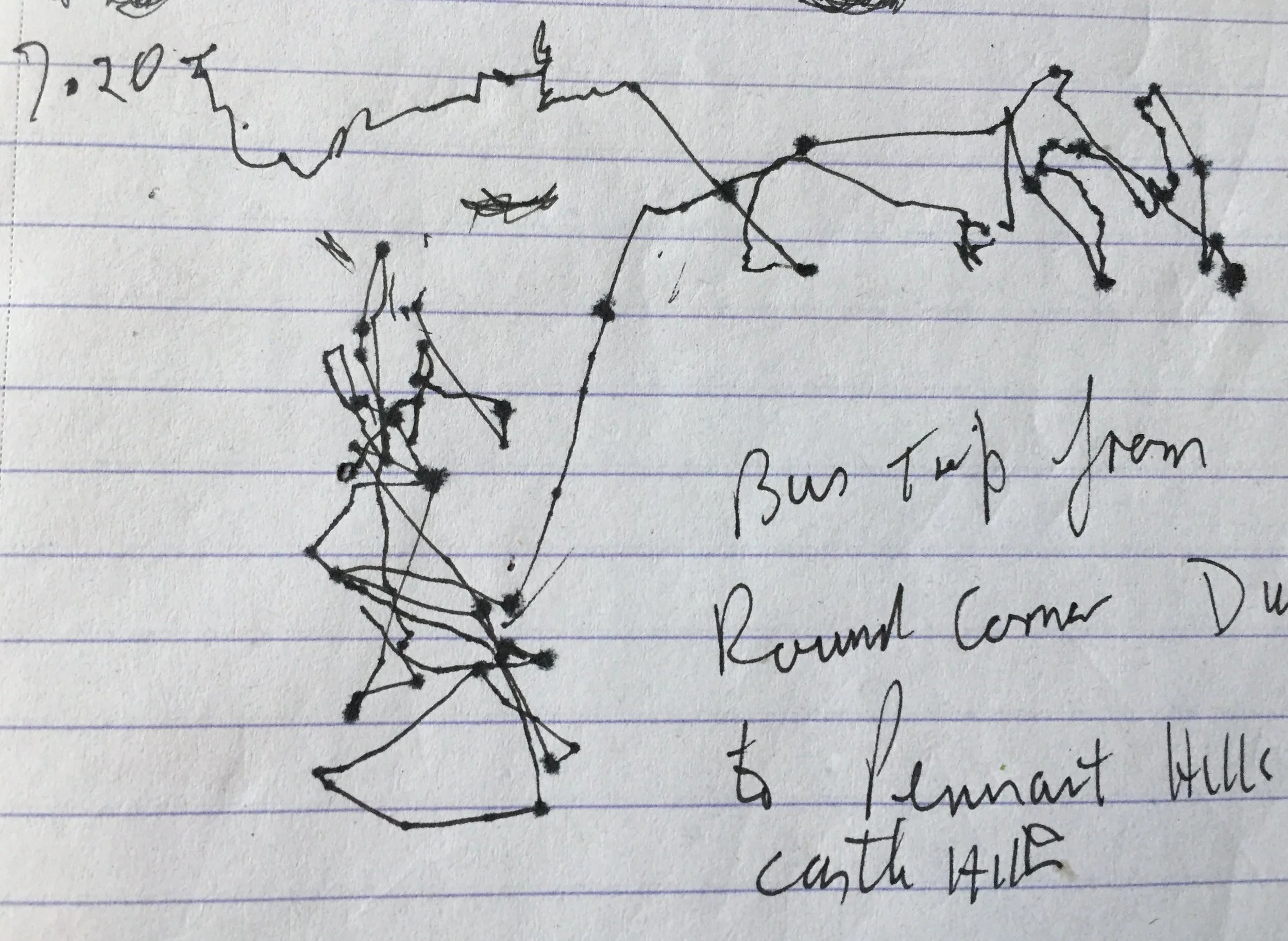
This drawing emerges from a bus journey taken from Pennant Hills toward the city, yet it does not attempt to depict the route, the landscape, or the recognisable markers of transit. Instead, it traces the felt movement of travel, the subtle shifts of balance, the rhythms of acceleration and pause, the quiet negotiations between body, awareness, and motion.
The project begins with a simple recognition: that much of what matters in our experience lies beyond immediate visibility. The world is always exceeding what can be directly seen. Drawing, in this context, becomes a way of staying in relation to that excess, not by trying to make the unseen fully visible, but by acknowledging its presence and allowing it to shape the mark‑making.
To draw is, here, to move attentively. It is a form of cognition that unfolds through the hand, a way of thinking that remains open rather than conclusive. The line becomes a companion to perception: following the sway of the bus, the interruptions of traffic, the small recalibrations of balance, the drifting of thought. What appears on the page is not a diagram of the journey but the residue of being carried through space.
This work invites viewers to consider how movement inscribes itself within us, how travel is not only a change of location but a shifting field of awareness. The drawing holds the traces of what lies just beyond view: the peripheral, the half‑noticed, the sensed rather than seen. It is an act of staying with emergence, of allowing the world’s subtle motions to register as line.
In this way, the drawing becomes less a record of where the artist travelled and more a record of how the journey was lived, a quiet cartography of attention.
This same condition unfolds in the act moving through, by walking or running…especially trail running, where perception is immediate, embodied and constantly adjusting. Each footfall becomes a form of sensing. The ground is not fully known in advance, it is encounted in fragments, shifts in texture, incline, moisture, resistance. The foot, like the eye in drawing, learns to read and respond before conscious thought intervenes. It finds its placement instinctively, negotiating rocks, roots and uneven terrain with a kind of tacit intelligence.
Drawing becomes inseparable from this experience. The hand, like the foot, moves ahead of cognition. Marks arrive on the page before they are fully understood, guided by rhythm, repetition, and subtle feedback from the surface. As in running, there is a continuous dialogue between body and environment, an attunement to forces that cannot be entirely seen or predicted.
Drawing and the Renewal of Meaning
Artifactual Fictions - Unseen Dialogue
Drawing as a Way of Knowing: Reconnecting Through Phenomenological Practice
Patrick Shirvington
Abstract
This reflective essay explores drawing as a phenomenological practice, a way of knowing the world rather than merely representing it. Through contemplation, intuition, and direct experience, drawing becomes a dialogue between the self and the living environment. Integrating ideas from Maturana, Bortoft, Franck, and Goethe, and inspired by the organic metaphor of mycelium, this paper proposes drawing as a living, cognitive act that reawakens our relationship with the unseen intelligence of the world.
Introduction
The practice of drawing has long been a way of knowing the world. My work seeks to enhance cognition through drawing — not as an exercise in representation, but as a means of reconnecting to the living world around us. We tend to look at the object, but do we truly see the subject? This project engages drawing not as a test of skill or draftsmanship, but as a tool for phenomenology .. an act of attention that deepens perception and understanding.
Drawing and Cognition
We often speak of ego: of what I have drawn, or what I was directed to draw. Yet, do we truly listen to what is behind the drawing, and engage in dialogue with our surroundings? Are we aware of all that is around us, not as isolated forms, but as a gathering of entities becoming one living field? As Humberto Maturana reminds us, “Living systems are cognitive systems, and living is a process of cognition” (1980, 13). To live is to know, and to draw is to participate in that knowing.
Even within spiritual traditions, there is a recognition of both the visible and invisible. The Nicene Creed speaks of belief “in all things, seen and unseen.” Through contemplation, we begin to sense this unseen dimension, a subtle layer of being that underlies what we perceive. Frederick Franck described this revelation beautifully:
“To stop rushing around, to sit quietly on the grass, to switch off the world and come back to earth, to allow the eye to see a willow, a bush, a cloud, a leaf, is an unforgettable experience” (1973).
In such stillness, drawing becomes both gesture and meditation, a bridge between self and world. The act of drawing is not about mastery of form, but the cultivation of presence. Patricia Cain once asked, “What have I come to know about the world through making this drawing?” (2010, 19). That question lies at the heart of this inquiry.
Phenomenology and the Act of Seeing
When we draw, we enter a dialogue between perception and being. Henri Bortoft described this as overcoming “the hiatus in experience”, the gap between habitual awareness and direct perception (2013, 67). Most of the time, we see in categories: we name, we classify, we move on. But drawing slows us down. It restores intimacy to looking, allowing the particular to reveal itself.
And yet, as artists, we often hesitate to allow intuition and the unseen to emerge in our work. We prefer the safe route, what can be justified or explained. But true creativity, like intuition, resists containment. Einstein described his thought processes as image-based and intuitive: “I never thought in logical symbols or mathematical equations, but in images, feelings, and even musical architectures” (Wertheimer 1959; Bernstein 2010). In that way, drawing too belongs to the realm of intuition — a way of entering the unknown through the hand.
The Oracle and Tacit Knowing
During a visit to the Temple of Apollo at Delphi, I was struck by the ancient inscription carved into the pediment: “Know thyself, and thou wilt know the Universe and the Gods.” This is not simply an invocation of self-awareness, but a reminder of our embeddedness in the cosmos. It speaks of a tacit knowledge, a dormant intelligence that lives within and between us, waiting to awaken through creative attention. Drawing, approached in this spirit, becomes an act of self-knowing that mirrors the knowing of the world.
Mycelium: The Great Nest of Knowledge
Here, the metaphor of mycelium offers a living symbol for this idea. Beneath the forest floor, a vast web of fungal threads connects trees, roots, and plants in a system of communication and exchange. Mycelium is invisible, yet essential, a great nest of knowledge that enables life to share information and energy. It is a form of collective intelligence, without hierarchy or centre.
So too with drawing. The drawn line extends outward like a mycelial filament, connecting the inner and outer worlds. The page becomes a living terrain — marks branching, interweaving, responding. Each stroke is a moment of dialogue between the mind, the body, and the material world. In this way, drawing mirrors the structure of the mycelium: decentralized, interconnected, and deeply attuned to its environment.
Goethe and the Phenomenology of Nature
Johann Wolfgang von Goethe’s delicate empiricism offers a conceptual foundation for this practice. Goethe invited us not merely to observe nature, but to participate in her unfolding, to let phenomena reveal themselves through empathy and attention. As David Seamon notes, Goethe’s approach “provides a lived means to allow the natural world to present itself in a way by which it might speak if it were able.” To draw in this spirit is to let the world draw itself through us, to listen, rather than impose.
Conclusion: Drawing as Living Inquiry
Drawing becomes a form of living inquiry, a phenomenological mycelium connecting self, medium, and world. Through the simple act of looking and marking, we rediscover our belonging to the greater web of life. Drawing does not impose order; it receives it. It teaches us to dwell within the world, to see not only the visible, but the invisible threads that bind all things into one.
In the end, to draw is to know, and to know is to participate. The world is not a collection of objects, but a communion of presences. Through the practice of drawing, this act of quiet attention, we reconnect to that communion, and remember that we, too, are part of the great nest of knowledge beneath the surface of all things.
References
Ashton, D. (2014). Drawing and the Drawing Process: A Phenomenological Approach. Routledge.
Bernstein, J. (2010). Einstein and the Artistic Imagination. Cambridge University Press.
Bortoft, H. (2013). The Wholeness of Nature: Goethe’s Way of Science. Floris Books.
Cain, P. (2010). Drawing: The Enactive Evolution of the Practitioner. Intellect Books.
Franck, F. (1973). The Zen of Seeing: Seeing/Drawing as Meditation. Vintage Books.
Maturana, H. (1980). Autopoiesis and Cognition: The Realization of the Living. Reidel.
Seamon, D. (2013). Goethe’s Way of Science: A Phenomenology of Nature. SUNY Press.
Wertheimer, M. (1959). Productive Thinking. Harper & Row.
Van Gogh - His last painting..
Beginning in the month of June 2018, my wife (Trish) and I had planned to travel south from Paris to follow the painting journey of Vincent Van Gogh.
However, before leaving Paris we decided to catch a train to Auvers-sur-Oise, (Vincent’s final resting place), as it was only a short trip north/east.
Upon our arrival we immediately visited Auberge Ravoux the guest house where Vincent lived.

Enjoying a wine with Vincent at Auberge Ravoux

Vincents room at the boarding house.
We left the guest house and made our way to where it was believed Vincent painted his last work Wheat Field with Crows. No further than 200m up the road, I stopped as something took my attention…I stood for a moment, for some reason to take a photo of where I was standing.

I then proceeded up the hill to where it was believed he completed his last work.
It wasn’t until two years later I read a newspaper article https://www.theartnewspaper.com/news/van-gogh-s-last-painting that I realised I had taken the photo in the exact spot of Vincent Van Gogh’s last painting.

It is indeed the very place where Vincent van Gogh's brushes touched his canvas for the last time. All the best, Wouter
I contacted Wouter van der Veen, the scientific director of the Institute van Gogh. His reply……
Hello Patrick,
What a wonderful coincidence. It is indeed the very place where Vincent van Gogh's brushes touched his canvas for the last time. All the best, Wouter